Elysium Security: ArbOS, HyperEVM & HyperCore
Explore Elysium security, from ArbOS block semantics and HyperEVM settlement to AnyTrust data availability and HyperCore integrations.
Elysium introduces a new execution environment to the Hyperliquid ecosystem, combining Arbitrum Nitro’s EVM execution with HyperEVM settlement and integrations with HyperCore’s native trading infrastructure.
For Solidity developers, this means familiar smart contracts can be deployed using existing Ethereum tooling, but the environment surrounding their execution is fundamentally different.
Elysium inherits its execution model from Arbitrum’s ArbOS, while settling to HyperEVM and integrating with HyperCore introduces settlement, data-availability, ordering, and cross-environment custody considerations that conventional EVM applications never encounter. Ethereum compatibility does not mean Ethereum-equivalent security assumptions.
1. ArbOS vs Ethereum: Understanding Elysium’s execution environment#
Elysium uses Arbitrum Orbit, powered by Nitro and ArbOS. Its EVM execution is based on Geth, allowing standard Solidity and Vyper contracts to execute without requiring a different smart contract language or compiler.
However, ArbOS is responsible for much more than providing an EVM-compatible environment.
Nitro separates transaction sequencing from deterministic execution. The sequencer receives and orders transactions, then publishes an ordered sequence of messages. Nitro’s state-transition function, incorporating Geth and ArbOS components, processes these messages, updates the L2 state, and produces L2 blocks.
ArbOS supplies the rollup-specific functionality surrounding EVM execution, including fee accounting, system interfaces, and parent-chain communication. Contracts therefore execute familiar EVM instructions, but the environment around them behaves differently from Ethereum.
Block numbers: block.number vs arbBlockNumber()#
One of the most important differences concerns Solidity’s block.number.
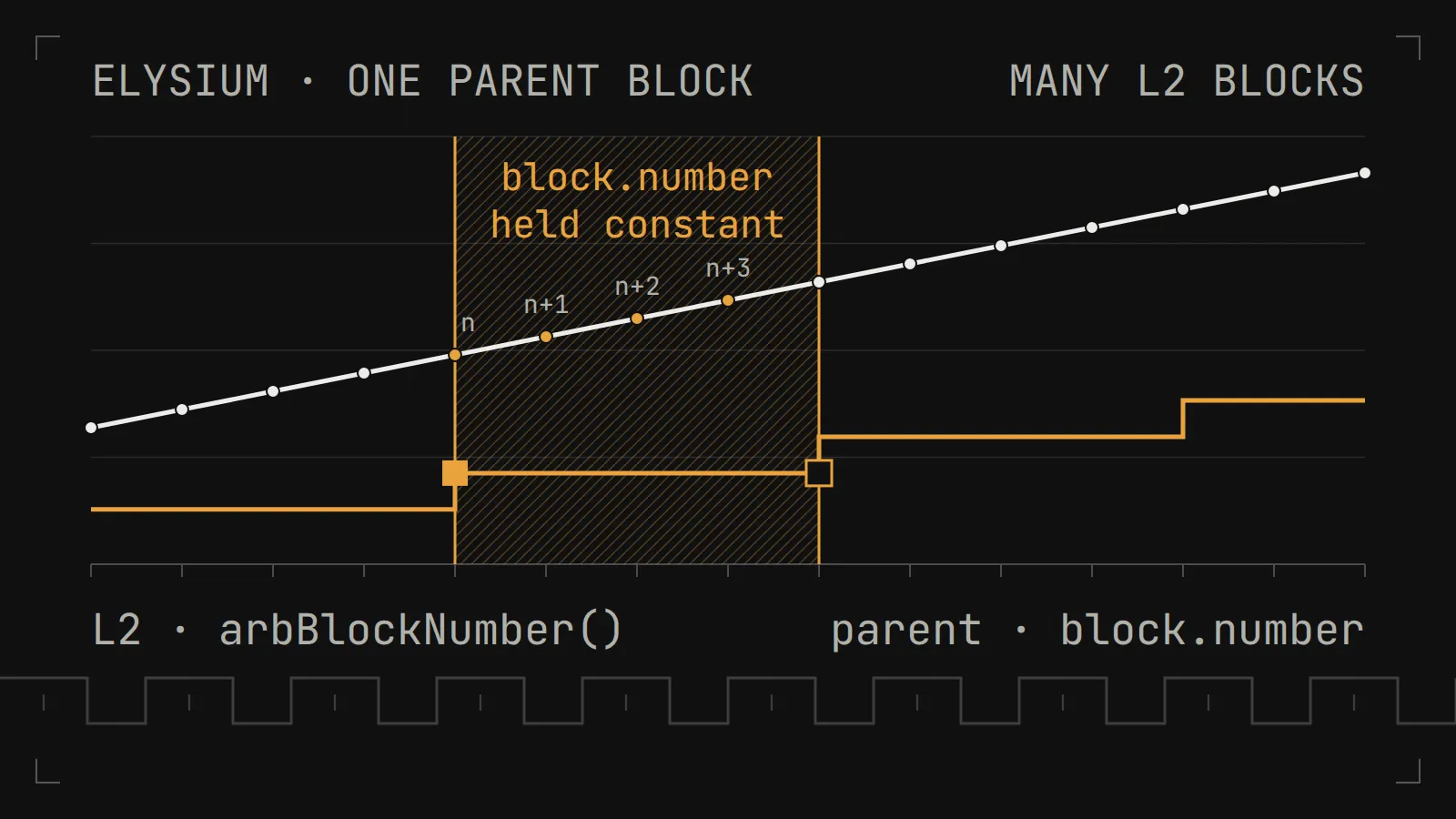
On Ethereum, block.number returns the current Ethereum block number. On Arbitrum, it returns an estimate of the block number of the first non-Arbitrum ancestor when the sequencer received the transaction.
For Elysium, that ancestor is HyperEVM.
This means developers need to distinguish between the parent-chain block number and Elysium’s actual L2 block height.
| Interface | Returns |
|---|---|
Solidity block.number | Approximate HyperEVM parent block number |
ArbSys.arbBlockNumber() | Actual Elysium L2 block number |
RPC eth_blockNumber | Current Elysium L2 block number |
Transaction receipt blockNumber | Elysium block containing the transaction |
Receipt l1BlockNumber | Approximate HyperEVM parent block number, where exposed by the RPC provider |
The actual Elysium block number is available through the ArbSys precompile at 0x0000000000000000000000000000000000000064.
For example:
interface IArbSys {
    function arbBlockNumber() external view returns (uint256);
}

IArbSys constant ARBSYS =
    IArbSys(0x0000000000000000000000000000000000000064);

function currentL2Block() external view returns (uint256) {
    return ARBSYS.arbBlockNumber();
}
This matters for staking, vesting, auctions, governance checkpoints, per-block limits, or any mechanism that assumes block.number is the local execution block. Consider a contract that limits withdrawals per block by resetting its counter whenever block.number changes: several Elysium blocks can share the same HyperEVM parent block number, so the limit applies across multiple Elysium blocks instead of resetting with each one.
Applications that depend on Elysium’s actual block progression should use arbBlockNumber() instead.
Block timestamps: Faster blocks do not mean finer timestamps#
Elysium targets approximately 100 ms canonical blocks, but Solidity’s block.timestamp uses second-level granularity, so multiple consecutive Elysium blocks can share the same timestamp.
ArbOS derives timestamps from the sequencer’s clock: they cannot decrease relative to preceding child-chain blocks and are bounded by the configured parent-chain timing parameters. For transactions forced through the delayed inbox, the timestamp follows additional rules based on the original parent-chain submission timestamp and the preceding L2 timestamp.
This matters for timestamp-based auctions, TWAPs, cooldowns, rate limits, and short oracle-validity windows. A mechanism assuming that every Elysium block represents a fixed fraction of a second cannot safely rely on integer block.timestamp increments.
Block hashes and randomness#
Other Solidity block properties also differ from their Ethereum counterparts.
| Property | ArbOS behavior |
|---|---|
blockhash(n) | Returns a pseudo-random child-chain block hash for eligible recent blocks; not suitable for secure randomness |
block.prevrandao | Constant 1 |
block.difficulty | Constant 1 |
block.coinbase | Internal sequencer address for sequenced messages; delayed messages have different handling |
Arbitrum documents the internal sequencer address for sequenced transactions as:
0xA4b000000000000000000073657175656e636572Protocols implementing lotteries, NFT allocations, gaming, or any mechanism that relies on unpredictable block properties must not reuse Ethereum randomness assumptions on Elysium; use an external randomness mechanism or a verifiable cryptographic design instead.
Similarly, block.coinbase must not be treated as Ethereum’s validator fee-recipient address.
Address aliasing and cross-chain msg.sender#
Arbitrum also introduces address aliasing for unsigned messages submitted through the delayed inbox.
When a parent-chain contract sends an applicable unsigned message to Elysium, the recipient contract does not see the original HyperEVM contract address as msg.sender.
Instead, its address is transformed:
child alias = parent contract address + 0x1111000000000000000000000000000000001111 (mod 2^160)This mechanism prevents a malicious Elysium contract from impersonating a parent-chain contract by deploying at the same address.
The official Arbitrum AddressAliasHelper library provides the appropriate implementation:
import {
    AddressAliasHelper
} from "@arbitrum/nitro-contracts/src/libraries/AddressAliasHelper.sol";

address aliasedSender =
    AddressAliasHelper.applyL1ToL2Alias(parentContract);
Applications receiving parent-chain messages, especially bridges, deposit callbacks, and privileged cross-chain instructions, must account for aliasing instead of comparing msg.sender against the original HyperEVM contract address.
ArbOS system interfaces#
Elysium also inherits Arbitrum-specific system interfaces beyond the standard Ethereum environment:
- ArbSys: L2 block information and cross-chain messaging.
- ArbGasInfo: Chain-specific gas and fee information.
- NodeInterface: Transaction estimation and fee-related functionality.
- Retryable transaction infrastructure: Parent-to-child message execution and recovery.
Test these against Elysium’s deployed ArbOS version; availability and configuration can differ from other Arbitrum chains.
Arbitrum: Block numbers and time · Arbitrum: Solidity support · Arbitrum: Address aliasing
2. Elysium vs Ethereum: The consequences of settling to HyperEVM#
Unlike conventional Arbitrum deployments, Elysium settles to HyperEVM rather than Ethereum, so its consensus, block production, fee environment, and settlement assumptions come from a different parent chain.
HyperEVM is not Ethereum#
HyperEVM is Hyperliquid’s general-purpose EVM execution environment.
HyperEVM and HyperCore should not be understood as two independent consensus networks. They are separate execution environments within Hyperliquid’s L1 architecture and share HyperBFT consensus.
HyperCore handles native financial execution, including spot and perpetual trading, while HyperEVM provides general-purpose smart-contract execution.
Elysium has a different relationship with these systems: it maintains its own rollup state and execution environment, using HyperEVM as its parent chain.
This means Elysium does not directly inherit Ethereum’s proof-of-stake validator security or Ethereum’s settlement guarantees. Its parent-chain security depends on Hyperliquid’s consensus infrastructure.
HyperEVM’s dual-block architecture#
Unlike Ethereum’s single execution-block sequence, HyperEVM separates throughput between two block types.
| Property | Small blocks | Large blocks |
|---|---|---|
| Target interval | 1 second | 60 seconds |
| Initial gas limit | 3 million | 30 million |
| Purpose | Faster transaction inclusion | Larger transactions and deployments |
Both block types use a single continuously increasing EVM block-number sequence, but transactions enter separate on-chain mempools.
For Elysium developers, this matters because the parent-chain block height returned through block.number follows HyperEVM’s execution sequence, not Elysium’s own 100 ms block sequence. There are three separate execution timelines, and they are not synchronized or interchangeable representations of time:
- Elysium: approximately 100 ms canonical blocks.
- HyperEVM: 1-second small blocks and 60-second large blocks under its documented initial configuration.
- HyperCore: approximately 70 ms trading-block cadence.
Settlement and transaction finality#
An executed Elysium transaction is not equivalent to a finalized cross-chain withdrawal. The lifecycle involves multiple stages:
- The Elysium sequencer receives and orders the transaction.
- The transaction executes on Elysium.
- Transaction data is made available through the selected data availability mechanism.
- The relevant batch or certificate is published to HyperEVM.
- The rollup’s state assertion progresses through its validation process.
- Withdrawals can be finalized and claimed on HyperEVM after the applicable challenge period.
A successful Elysium transaction receipt therefore does not mean the corresponding withdrawal is available. Applications handling collateral, redemptions, or cross-chain balances should distinguish sequencer confirmation, data publication, state validation, parent-chain finality, and withdrawal completion.
Gas accounting and HYPE#
Elysium uses HYPE as its native gas asset.
HYPE moves between HyperEVM and Elysium at a 1:1 ratio as native value, without introducing a separate wrapped token for gas.
However, developers should not assume that Elysium uses Ethereum’s exact gas economics.
ArbOS accounts for two broad cost components:
- Execution resources consumed on Elysium.
- The cost associated with publishing transaction data or its availability certificate to the parent chain.
These costs are generally combined into a single transaction fee.
Elysium’s AnyTrust configuration changes the data-publication mechanism. In the normal path, the committee retains the full transaction data while a compact Data Availability Certificate is posted to HyperEVM. If the chain falls back to full-data posting, its parent-chain data costs change accordingly.
Arbitrum’s NodeInterface.gasEstimateComponents() can expose the estimated components of a transaction fee, while eth_estimateGas provides a combined gas estimate.
Developers should use the network’s gas estimation mechanisms rather than hardcoding Ethereum gas assumptions, and account for HYPE’s native-value behavior (msg.value, payable entry points, refunds) wherever precise transaction costs matter.
Hyperliquid: HyperEVM · Hyperliquid: Dual-block architecture · Arbitrum: Gas estimation
3. Elysium’s rollup security: Sequencers, AnyTrust, and validation#
Elysium’s security model is not determined by HyperEVM consensus alone.
As an optimistic rollup using Arbitrum Nitro, it has its own transaction sequencing, data availability, state-validation, and withdrawal mechanisms.
These components introduce separate trust assumptions that applications should understand.
Single sequencer and transaction ordering#
Elysium’s documented initial configuration uses a single sequencer.
Transactions are ordered by priority fee within each block, with no privileged transaction lanes.
This optimizes for frequent inclusion but makes the sequencer an infrastructure dependency: downtime, censorship, and ordering discretion directly affect time-sensitive operations such as liquidations, keeper activity, swaps, and auctions.
Forced inclusion through the delayed inbox#
Arbitrum Nitro provides a delayed-inbox mechanism through which users can submit transactions through the parent chain without relying on ordinary sequencer inclusion.
If the sequencer ignores a delayed message, anyone can force its inclusion after the configured window has passed.
The effective force-inclusion window is the smaller of the configured delayBlocks limit and the applicable delay-buffer window.
The relevant deployment settings include:
maxTimeVariation.delayBlocks, which establishes the maximum force-inclusion window.bufferConfig, where the censorship-timeout delay buffer is configured.- The delayed Inbox’s allowlist (
setAllowListEnabled) and pause state, and the SequencerInbox’s batch-poster authorization.
The delay buffer can shorten the wait after prolonged sequencer delays, depending on how the SequencerInbox was deployed and configured. Forced inclusion is also not unconditional if the chain owner has restricted the Delayed Inbox with an allowlist or pause.
AnyTrust data availability#
Elysium uses AnyTrust data availability.
Instead of publishing all transaction data directly to HyperEVM, the chain uses a Data Availability Committee (DAC) that stores the full data and provides a compact Data Availability Certificate (DACert).
AnyTrust’s threshold model is parameterized by:
N: Total number of committee members.H: Minimum number of members assumed to remain honest.K: Number of signatures required for a valid certificate.
The required signature threshold is:
K = N + 1 - HFor example, a committee with five members and two assumed honest members requires four signatures.
This ensures that every valid certificate includes at least one honest signer, provided the assumed honesty threshold holds.
If the committee cannot provide enough signatures, the documented design falls back to publishing full transaction data to HyperEVM, unless the fallback has been disabled. This fallback does not eliminate every failure mode.
If enough malicious members reach the signature threshold, they can produce valid certificates without actually retaining the data, leaving independent nodes unable to reconstruct it. The consequence is a data-availability and liveness failure: validators cannot validate new assertions, but the committee cannot forge transactions, mint tokens, or move funds, and previously confirmed assertions remain confirmed.
Committee governance matters as much as the threshold math. Membership is permissioned, and the chain owner registers the committee keyset on the SequencerInbox via setValidKeyset(), so the account holding that authority can replace the committee at will. When evaluating Elysium, investigate the deployed committee membership and its N, H, and K; who controls the keyset authority; the members’ independence and data-retention behavior; and whether independent operators can reconstruct historical chain state.
Data retention and confidentiality#
AnyTrust should not be confused with a confidentiality mechanism.
Committee members receive the underlying transaction data, and the Data Availability Server exposes data through its REST interface. AnyTrust does not encrypt transaction batches or prevent committee members and other authorized data consumers from reading them.
There is also a distinction between requested data retention and guaranteed historical availability.
Arbitrum’s generic batch-poster configuration defaults to requesting 360 hours (15 days) of retention through node.batch-poster.anytrust-retention-period. This is a requested retention period, not an unconditional guarantee that every committee member will retain data for that entire period.
Separately, Arbitrum’s node validation logic rejects a DACert whose expiry is less than one week beyond the batch’s maximum timestamp.
Neither mechanism creates a permanent archive.
Applications and infrastructure providers requiring long-term historical availability should operate an archive or mirror Data Availability Server rather than depending exclusively on the committee.
Elysium’s actual committee settings and retention configuration must be verified independently.
Permissionless validation and BoLD#
Elysium’s roadmap identifies permissionless Arbitrum BoLD proving as a later hardening milestone.
BoLD is designed to make rollup assertion validation permissionless and provide bounded dispute resolution.
However, the existence of BoLD in the underlying Arbitrum technology does not automatically mean that Elysium has permissionless validation from launch.
Developers should verify the actual validator authorization policy and deployed configuration.
The distinction between the underlying fraud-proof mechanism and the parties currently permitted to participate is important when evaluating Elysium’s security assumptions.
Arbitrum: AnyTrust protocol · Arbitrum: AnyTrust trust model · Arbitrum: Forced transactions
4. HyperCore integration: What makes Elysium different from other Orbit chains?#
The most distinctive part of Elysium’s architecture is its relationship with HyperCore.
HyperCore is Hyperliquid’s native execution environment for financial markets. It manages spot and perpetual order books, prices, balances, positions, and related trading functionality.
Unlike HyperEVM, HyperCore is not a conventional EVM environment where applications interact through ordinary Solidity contracts.
Elysium is designed to bridge this gap by introducing native interfaces for reading HyperCore state and initiating trading operations.
Importantly, these integrations are planned as post-launch ArbOS upgrades.
Reading HyperCore state through a native precompile#
The planned HyperCore market-data precompile allows Elysium contracts to read information directly from HyperCore.
Its documented capabilities include:
- Spot, oracle, and mark prices.
- Order books at different depth levels, including full depth.
- Account balances and positions.
- Market depth and liquidity information.
- Flow imbalance and expected slippage calculations.
This is significantly different from the conventional oracle model.
Traditional oracle integrations usually require external updates to be published on-chain, either through individual update transactions or an oracle network’s predefined update mechanism.
The planned Elysium precompile instead exposes HyperCore state through a native interface, without requiring conventional oracle-update transactions.
However, this does not mean the data is trustless.
Kinetiq’s documented design uses a dedicated, co-located Hyperliquid node as the source of HyperCore state for the planned Elysium market-data interface.
Each response is designed to include the originating HyperCore block height and timestamp, allowing applications to evaluate its freshness. The design also describes exposing stale data as stale rather than silently treating outdated information as current.
There is an important distinction between freshness and authenticity.
The published integration design describes sequencer-attested data rather than an independently verifiable HyperCore state proof. It does not describe a contract-verifiable proof against a HyperCore state root that an Elysium application could independently validate.
Applications consuming the data should weigh four factors:
Freshness validation: enforce a maximum permitted data age using the returned HyperCore block height and timestamp.
Sequencer trust: the integration relies on the sequencer’s attestation of the data its infrastructure returns.
Price integrity: a valid and fresh response does not make a price suitable for every application; thin books, insufficient depth, and manipulation remain relevant.
Execution consistency: the market state a contract observes can differ from the state at which a subsequent transaction executes.
Kinetiq describes a freshness target of approximately 150 to 350 ms inside the EVM, a design target rather than a guaranteed latency. For protocols using these interfaces, freshness and market-data validation will be important audit considerations.
Trading on HyperCore through ElysiumCoreWriter#
Elysium also plans a native trading interface called ElysiumCoreWriter.
It allows smart contracts on Elysium to initiate trading actions on HyperCore without moving the user’s assets into the Elysium contract.
The intended execution flow is:
- The application binds a HyperCore trading account through the ElysiumCoreWriter predeploy.
- The HyperCore account authorizes a trade-only API agent.
- The Elysium contract emits an order intent.
- A keeper processes the intent and signs the corresponding action using the authorized agent.
- HyperCore executes the order on the user’s account.
- An optional callback reports the outcome to the originating Elysium contract.
The custody model is the key property: HyperCore restricts the agent to placing and canceling orders; it cannot withdraw or transfer the user’s funds, and the user can revoke the agent independently of Elysium.
However, execution is asynchronous. An Elysium transaction that emits an order intent does not mean the HyperCore trade executed: market conditions may change, orders may be rejected, and partial fills may occur. There is no atomic transaction spanning Elysium and HyperCore.
Applications must therefore handle replay protection and intent-nonce management, authenticated and idempotent callbacks, partial fills and cancellations, failed or delayed executions, order expiry, and keeper availability. Kinetiq describes an optional on-chain result callback funded through a HYPE gas escrow; callback implementations should deduplicate by intent nonce.
Treat a successful Elysium transaction as the submission of a trading intent, not proof that the order filled. This is a fundamentally different model from calling another Solidity contract synchronously.
Sources: Kinetiq: HyperCore market data · Kinetiq: Trading on HyperCore from Elysium
5. What should developers reconsider when deploying on Elysium?#
Elysium retains normal EVM execution, so conventional Solidity vulnerabilities do not disappear. Reentrancy, access-control errors, signature validation mistakes, incorrect accounting, and unsafe external calls remain relevant.
However, applications should also be assessed against the infrastructure assumptions introduced by ArbOS, HyperEVM, and HyperCore.
A useful Elysium-specific audit checklist includes:
| Area | What to review |
|---|---|
| Block context | block.number versus arbBlockNumber() |
| Time-dependent logic | Timestamp granularity and sequencer timing configuration |
| Randomness | Inappropriate use of block hashes or prevrandao |
| Cross-chain authentication | Address aliasing and messenger verification |
| Fee handling | HYPE, gas estimation, and native refunds |
| Sequencing | Availability, priority ordering, and censorship assumptions |
| Data availability | AnyTrust committee threshold, retention, governance, and fallback |
| Settlement | Challenge periods and withdrawal finality |
| Market data | HyperCore response freshness and sequencer attestation |
| Trading integration | Asynchronous execution, callbacks, and intent deduplication |
The goal is not to treat every inherited ArbOS feature as a vulnerability. It is to identify where Ethereum-based application assumptions no longer accurately describe the target execution environment.
Conclusion: Elysium is EVM-compatible, not Ethereum-equivalent#
Elysium combines three distinct security environments.
ArbOS determines how EVM applications execute, including block context, transaction processing, fee accounting, and cross-chain messaging.
HyperEVM provides the parent-chain settlement environment and introduces Hyperliquid’s own consensus, block-production, and data-availability context.
HyperCore adds an additional financial execution environment, with native order books, account state, and planned integrations that allow Elysium contracts to consume market data and initiate trading actions.
These differences determine what developers can safely assume about time, block progression, ordering, settlement, data availability, custody, and cross-environment execution.
Securing protocols building on Elysium#
A security review should go beyond conventional Solidity vulnerabilities to examine how a protocol’s assumptions interact with ArbOS, HyperEVM settlement, cross-chain messaging, and HyperCore integrations.
At Parapet Labs, we’re interested in collaborating with teams building on emerging EVM ecosystems, providing senior-led smart contract reviews that account for the infrastructure surrounding the application, not just the code itself.
Whether you’re preparing a new deployment or reviewing an existing protocol, we’d be glad to discuss how we can help strengthen its security. We are currently giving away $2,000 worth of audit credits as grants, which can be applied toward your upcoming private audit with us. We also offer flexible collaboration arrangements depending on the project’s scope and our current capacity.
Explore Parapet Labs security services.
References and further reading#
- Kinetiq: Elysium technical overview
- Kinetiq: Blocks, fees, and ordering
- Kinetiq: Security and data availability
- Arbitrum: Block numbers and time
- Arbitrum: Solidity support
- Arbitrum: Address aliasing
- Arbitrum: AnyTrust protocol
- Arbitrum: AnyTrust trust model
- Arbitrum: Forced transactions
- Arbitrum: Gas estimation
- Hyperliquid: HyperEVM
- Hyperliquid: Dual-block architecture
- Kinetiq: HyperCore market data
- Kinetiq: Trading on HyperCore from Elysium