How to Secure Your Protocol on Robinhood Chain
Learn to secure protocols on Robinhood Chain, from equity-oracle risks and corporate-action pauses to feed decimals and cross-chain messaging.
Imagine an on-chain portfolio vault that holds a basket of Robinhood Stock Tokens and issues its own shares to depositors. The vault uses Chainlink feeds to calculate its net asset value (NAV), price share minting and redemptions, and inform portfolio rebalancing. The feed call succeeds, the answer is positive, and the transaction does not revert. Yet the price may be stale, may include a dividend-reinvestment adjustment, or may be held while a corporate action is being processed.
A misread price can make the vault mint too many or too few shares, redeem at the wrong NAV, or rebalance using incorrect asset weights. Value can move between entering, exiting, and remaining holders even though the oracle call itself succeeded.
None of those cases necessarily looks like a conventional Solidity bug. They are integration failures: the contract’s assumptions do not match the asset or infrastructure it is using.
This guide focuses on vulnerabilities and design decisions that arise from deploying on Robinhood Chain. General EVM issues such as reentrancy, access-control mistakes unrelated to chain integration, and faulty accounting are intentionally outside its scope.
EVM compatibility is a starting point, not a security review#
Robinhood Chain is a permissionless, Ethereum-compatible Layer 2 built on Arbitrum Dedicated Blockchain technology. Solidity contracts and standard EVM tooling work in the familiar way. That portability makes deployment easier, but it does not guarantee identical infrastructure, price-feed availability, trading sessions, or cross-chain behavior. See the official chain overview.
Think of the deployment in two layers. The first is the contract’s own logic, which must be secure on every chain. The second is the set of external assumptions the contract makes about this environment. This article is about the second layer.
Robinhood Chain also supports ERC-4337 account abstraction, including programmable wallets, batching, session keys, and sponsored gas. This guide focuses on chain-specific oracle and cross-chain integration risks, so account-abstraction security is outside its scope.
Do not confuse an available token with a tradeable market#
Crypto markets operate continuously. Equity data and trading do not follow the same schedule. Robinhood’s tokenized-equity Chainlink feeds are configured for 24/5 sessions, including regular, pre-market, post-market, and overnight trading where liquidity and data quality support it. During weekends, market holidays, and thin overnight windows, a feed may retain the last published price. The contract can still answer latestRoundData(), and these feeds do not have heartbeats during off-hours. Chainlink documents these session rules here.
That creates a subtle failure mode: a successful read is not proof that the price reflects the current market. A fixed staleness threshold copied from a crypto feed can also be wrong for an equity feed. If it is too loose, the vault may price shares using a value that no longer represents a reasonable portfolio valuation. If it is too strict, valuation-dependent operations such as share minting or redemption may become unavailable during a normal market closure.
Make freshness a product decision#
Read updatedAt and define a staleness policy based on the feed’s documented sessions and the vault’s accounting model. A read-only portfolio display, NAV calculation, vault-share mint, redemption, and automated rebalance do not necessarily need the same policy. Decide what each operation does when an observation is too old instead of letting a generic require accidentally dictate the entire application’s behavior.
A second session boundary: Oracle freshness and trading capability are different questions. A price feed can publish a reference value when a particular stock token cannot be traded during that session. Robinhood documents both a tokenization window for minting and burning, and per-asset trading capabilities that vary by underlying security. Query the current
tradingCapabilitiesin the Stock Token Assets API before building session-sensitive trading flows. Treat missing or null capability fields as unknown, not as permission to trade.
There is another mismatch worth avoiding if your protocol has an off-chain service. Robinhood’s REST /prices endpoint returns the raw underlying-equity bid and ask, while the on-chain Chainlink feed is multiplier-adjusted. Do not compare those figures as if they had identical semantics. If a backend needs the token-equivalent price, it must apply the relevant current multiplier consistently and handle cached responses according to the API documentation. Source: Stock Token APIs.
The feed reports total-return value, not just the share price#
This is one of the most important details in the Robinhood integration. Chainlink’s Robinhood tokenized-equity feed combines the underlying equity’s market price with the multiplier read from the relevant Robinhood token contract through uiMultiplier(). The resulting value reflects dividend reinvestments and corporate-action adjustments rather than only the raw market price per share.
Token price = underlying equity market price × uiMultiplier() = token total-return value.
Consider the documented dividend-reinvestment example. If the underlying equity remains at $200 and the multiplier moves from 1.000 to 1.008, the token’s total-return value becomes $201.60.
$200.00 × 1.008 = $201.60.
If the vault assumes that one token’s value is always equal to the raw underlying share price, its NAV may be wrong. That can distort the number of vault shares issued or redeemed and shift value between participants. The reverse mistake is possible too: applying a second dividend or split adjustment after the feed has already incorporated it can count the same adjustment twice.
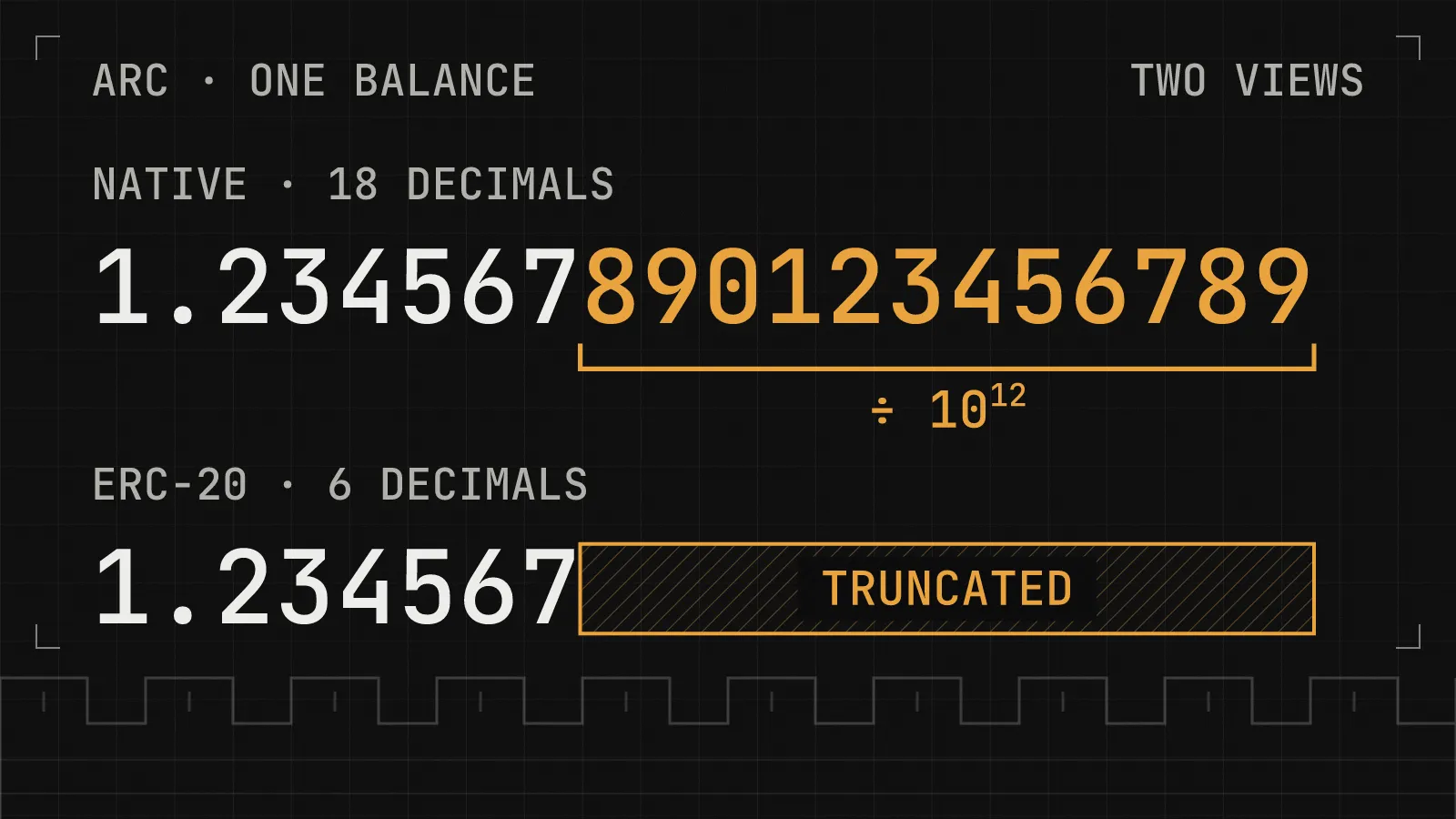
Tokenized equity contracts themselves are ERC-20s with 18 decimals, but that does not tell you how many decimals the corresponding oracle answer uses. Token precision and oracle precision are separate interfaces and must be handled separately.
- Verify the feed proxy belongs to the intended ticker and chain.
- Know whether portfolio NAV and vault-share accounting expect raw market price or token total-return value.
- Test small multiplier changes, scheduled changes, and corporate-action edge cases.
- Do not independently reapply adjustments already included by the feed.
Reference: Chainlink’s Robinhood Tokenized Equities documentation.
A corporate-action pause is not an ordinary stale-price event#
Stock splits and reverse splits can change the relationship between a token’s balance and the underlying equity exposure. Robinhood’s token contract exposes the multiplier update process, including newUIMultiplier(), effectiveAt(), and the UIMultiplierUpdated event.
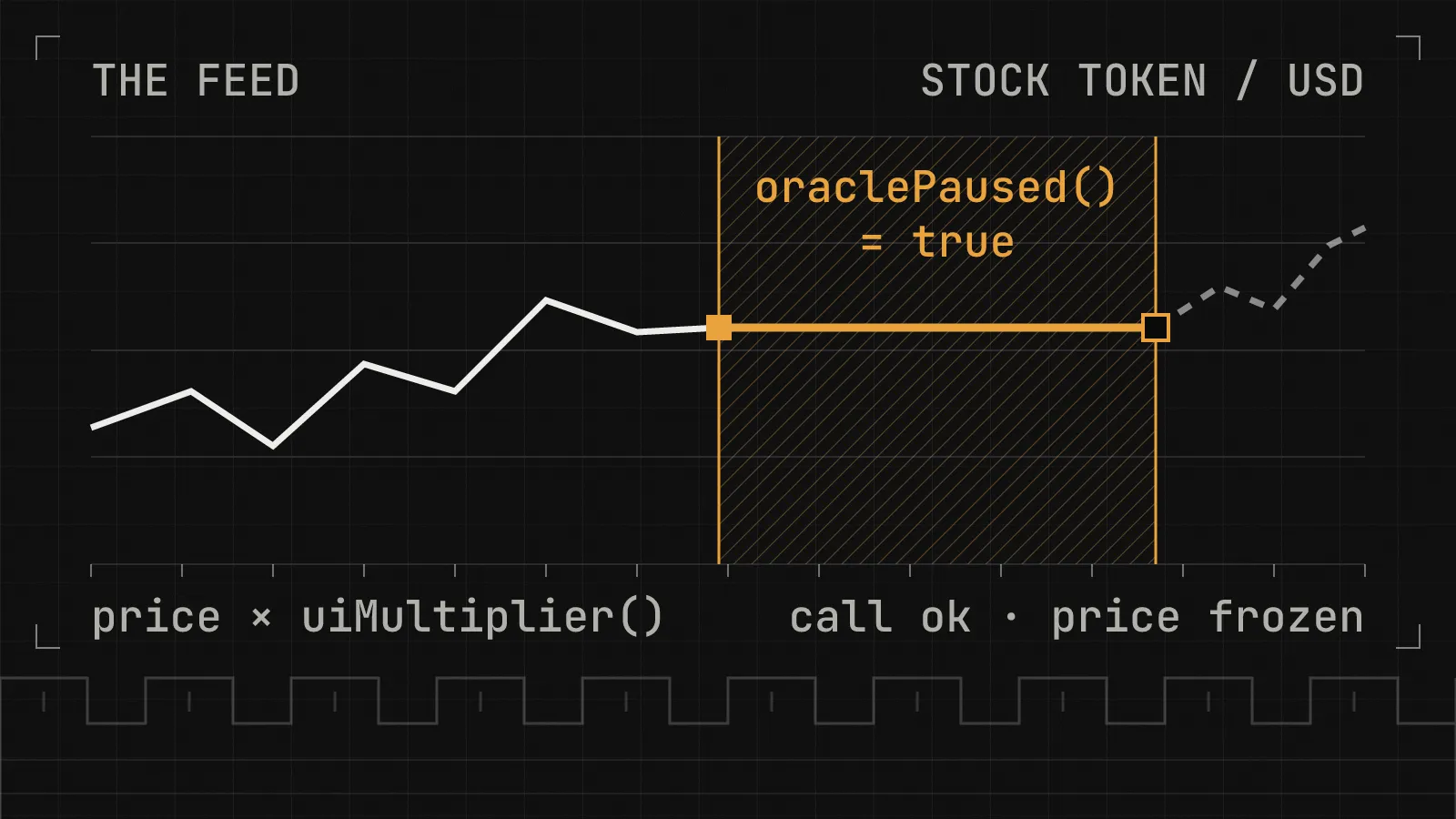
For large changes that could create a price discontinuity, Robinhood stages the multiplier and pauses the oracle. While oraclePaused() is true, the feed stops publishing new prices and holds the last known good value. Once the underlying price and multiplier are aligned, the oracle can be unpaused. Chainlink also notes that corporate-action timing and pause coordination are handled by Robinhood, not by Chainlink.
For a simplified 10-for-1 split, the underlying share price might move from $200 to $20 while the multiplier changes from 1.0 to 10.0. The intended token valuation stays continuous at $200. The pause prevents the feed from publishing an inconsistent intermediate combination of those values. See Chainlink’s documented split scenario.
What the vault should decide#
A stale-price threshold alone is not a complete corporate-action policy. A pause can be short enough that a generic age limit has not expired, while the value is intentionally frozen. Where the risk warrants it, read oraclePaused() from the corresponding token contract as a separate signal.
Then decide how each vault operation should behave. Minting new vault shares against a frozen or inconsistent NAV can dilute existing holders. Redeeming at the wrong NAV can transfer value from remaining holders to departing holders. Rebalancing on a frozen price can also use misleading portfolio weights. Depending on the design, the vault might pause NAV-dependent minting, redemptions, or rebalancing until a reliable valuation is available. Do not blindly freeze every user exit either: decide in advance whether an in-kind exit or another safe path is possible without relying on the questionable price. The right response depends on how the vault prices shares, which assets it holds, and how it can resume normal operation.
Tests should include the complete lifecycle: stage a multiplier, enter the pause, simulate the underlying stock’s split-adjusted price, cross the effective timestamp, and resume the feed. Add mismatched-timing cases instead of testing only the happy path.
Never assume a USD feed has eight decimals#
An oracle’s denomination does not determine its precision. Chainlink’s AggregatorV3Interface.decimals() returns the number of decimal places used by that feed’s answer. Read it from the actual configured proxy and normalize prices explicitly. Source: Chainlink Data Feeds API.
| Raw answer | Feed decimals | Interpreted price |
|---|---|---|
20000000000 | 8 | $200.00 |
200000000000000000000 | 18 | $200.00 |
The same $200 value can have very different raw integers. A hardcoded eight-decimal assumption applied to an eighteen-decimal feed changes the interpreted value by ten orders of magnitude. If that value feeds portfolio NAV, vault-share minting or redemption, or rebalance sizing, the error can become financially critical.
The helper below validates a positive answer and timestamp, then normalizes a price to 18 decimals. Set MAX_FEED_DECIMALS to the highest feed precision your integration supports.
Example: Solidity price normalization to 18 decimals
function readPriceWad(
    AggregatorV3Interface feed,
    uint256 maxAge
) internal view returns (uint256 priceWad) {
    (
        ,
        int256 answer,
        ,
        uint256 updatedAt,
    ) = feed.latestRoundData();
    if (answer <= 0) revert InvalidPrice();
    if (updatedAt == 0 || updatedAt > block.timestamp) {
        revert InvalidTimestamp();
    }
    if (block.timestamp - updatedAt > maxAge) {
        revert StalePrice();
    }
    uint256 sourceDecimals = uint256(feed.decimals());
    if (sourceDecimals > MAX_FEED_DECIMALS) {
        revert UnsupportedDecimals();
    }
    uint256 unsignedAnswer = uint256(answer);
    if (sourceDecimals < TARGET_DECIMALS) {
        uint256 scale = 10 ** (TARGET_DECIMALS - sourceDecimals);
        if (unsignedAnswer > type(uint256).max / scale) {
            revert PriceOverflow();
        }
        priceWad = unsignedAnswer * scale;
    } else if (sourceDecimals > TARGET_DECIMALS) {
        uint256 divisor = 10 ** (sourceDecimals - TARGET_DECIMALS);
        priceWad = unsignedAnswer / divisor;
    } else {
        priceWad = unsignedAnswer;
    }
    if (priceWad == 0) revert PriceRoundsToZero();
}
Before deployment, add feed-address allowlisting, explicit handling for asset-specific oracle pauses, a supported-market-session policy, and vault-specific NAV and share-accounting safeguards. Review rounding behavior and use full-precision arithmetic for downstream ratios. Compile and test with the exact dependency versions you deploy.
Two more checks matter after normalization. First, define what maxAge means for a feed that can remain unchanged during off-hours. Second, validate the configured feed and asset identity rather than assuming a technically valid answer belongs to the intended market.
Do not copy an Arbitrum One sequencer feed address#
Layer 2 applications need a plan for sequencer downtime and recovery. Chainlink’s L2 Sequencer Uptime Feeds can help supported networks detect outages and enforce a grace period before sensitive actions resume.
However, a chain being built with Arbitrum nitro fork does not automatically mean a Chainlink uptime feed is deployed for it. As checked on 22 October 2026, Robinhood Chain is not listed among the networks supported by Chainlink’s L2 Sequencer Uptime Feeds documentation. Chainlink’s documentation also says it is no longer expanding these feeds to additional networks. Check the current official list before deployment.
Address aliasing: authenticate the caller you actually receive#
Robinhood Chain uses the Arbitrum Nitro messaging system, so applications receiving Ethereum-to-Robinhood messages must account for the sender address they actually observe.
Robinhood Chain supports arbitrary messaging between Ethereum and Robinhood Chain through standard Arbitrum Nitro mechanisms. Ethereum-to-Robinhood messages use retryable tickets through the Delayed Inbox and typically complete in minutes. In the reverse direction, an L2 message can be executed on Ethereum after the seven-day challenge period. A submitted transaction on the source chain is not proof that the destination operation has completed. Read the Robinhood messaging guide.
What address aliasing changes#
When an L1 contract calls an L2 contract through an unsigned Delayed Inbox message or retryable ticket, the receiving contract does not necessarily see the original L1 contract address as msg.sender. Arbitrum applies a fixed offset to the L1 contract address, creating an aliased child-chain address:
L2 msg.sender = L1 contract address + Arbitrum alias offset.
The offset commonly used by Arbitrum is 0x1111000000000000000000000000000000001111, with address arithmetic defined by the protocol. The mechanism prevents an L1 contract from being impersonated on L2 at its unmodified address. See Arbitrum’s explanation of L1-to-L2 messaging.
Imagine an L1 operations contract authorized to update a setting on a portfolio vault deployed on Robinhood Chain. If the receiving contract compares msg.sender directly with the original L1 address, the legitimate message can fail because the L1 sender is aliased on L2. A rushed workaround that weakens the access check can create a more serious authorization problem.
Practical rules for the receiver#
- Use the
@arbitrum/sdkand established Arbitrum alias helpers rather than hand-rolling message construction. - When L2 contract logic verifies an L1 counterpart, use the canonical on-chain alias helper for the deployed Arbitrum version and compare against a configured, trusted counterpart.
- Do not blindly undo the alias for every caller. The expected message route and trusted counterpart must be part of the authorization model.
- Handle retries, delayed execution, failed redemption, duplicate attempts, and out-of-order business operations explicitly.
Retryable tickets whose L2 execution fails, for example because of insufficient gas, may need manual redemption within the documented seven-day window. The L2-to-L1 path is also asynchronous: final execution happens on Ethereum after the challenge period and an Outbox execution step. Design a message lifecycle with explicit pending, executed, and recoverable failure states. Do not build cross-chain logic as if both chains were one synchronous transaction.
The Robinhood Chain integration checklist#
Use this list during implementation review and turn each item into an automated test or a documented operational control.
Stock tokens and oracles#
- Confirm the token and Chainlink feed addresses correspond to the intended asset on Robinhood Chain Mainnet.
- Use the feed’s total-return semantics, including
uiMultiplier(), consistently when calculating portfolio NAV and vault-share value. - Test dividend reinvestment, multiplier changes, splits, reverse splits, and mismatched corporate-action timing.
- Define behavior when
oraclePaused()is true for NAV calculations, share minting/redemption, and rebalancing, not only whenupdatedAtexceeds a generic age limit. - Set an explicit staleness policy for weekends, holidays, and thin overnight sessions.
- Read
decimals()from the configured feed and test both lower and higher precision than the vault’s internal representation. - Keep REST raw-price semantics separate from the multiplier-adjusted on-chain feed value.
- Check current asset-level trading capabilities before session-sensitive trades or rebalances.
Layer 2 and cross-chain#
- Verify whether a sequencer uptime feed is deployed and supported on the exact target chain. Never reuse a feed address from another L2.
- Use supported Arbitrum SDK utilities and verify alias-aware authorization for Ethereum-to-Robinhood calls.
- Model message delays, the seven-day L2-to-L1 challenge period, retries, and recoverable failures.
- Test duplicate messages and ensure a message cannot execute the same privileged business action twice.
- Document safe behavior during oracle pauses, stale prices, and unusual chain conditions.
The security principle: The safest integration is the one that knows when its assumptions stop being true, and has a deliberate response ready before that moment arrives.
Building on Robinhood Chain? Let’s Talk.#
This guide is a first step toward securing your protocol. If you’re looking to go deeper, with senior security researchers examining your code and its assumptions, we’d love to explore a collaboration.
We’re particularly interested in working with teams building on Robinhood Chain. Depending on our current capacity and the scope of your project, we may be able to offer selected teams especially favorable terms.
Tell us what you’re working on. We’d be glad to discuss how we can help secure it.
Primary documentation#
Use these primary references to verify deployments, addresses, API fields, and package versions during implementation.
- About Robinhood Chain
EVM compatibility and chain architecture. - Robinhood Stock Tokens
Token interface, tokenization window, and per-asset trading sessions. - Stock Token APIs
Asset metadata, multiplier fields, trading capabilities, and price semantics. - Chainlink Robinhood Tokenized Equities
Total-return calculation, corporate-action pauses, and off-hours behavior. - Chainlink Data Feeds API Reference
decimals()andlatestRoundData(). - Chainlink L2 Sequencer Uptime Feeds
Current supported-network list and integration caveats. - Robinhood Chain Cross-Chain Messaging
Retryable tickets, the Outbox flow, and address aliasing. - Arbitrum L1-to-L2 Messaging
Why address aliasing exists and how it is calculated.